
Key Takeaways
-
Equipment repairs require a Swimming Pool and Spa Contractor’s License in Florida; basic residential cleaning does not, but verify credentials before hiring to avoid legal issues.
-
Commercial pools require Public Pool Service Technician Certification in Florida; property managers must confirm this specific credential is held, not just residential cleaning experience.
-
CPO (Certified Pool Operator) certification and state contractor licenses are different credentials; the best companies hold both for complete authorization and expertise in repairs and maintenance.
-
Verify pool service credentials by requesting the license number and checking it free on Florida DBPR website; also confirm general liability and workers’ compensation insurance before signing contracts.
-
Florida contractor applicants must demonstrate four years of construction experience and credit score around 660+; licensed services provide legal compliance, equipment protection, and long-term cost savings.
-
Red flags include inability to provide license numbers, no physical address, lack of written agreements, and inconsistent technicians; professional companies should handle repairs in-house for accountability.
Your pool is one of the best parts of your Tampa home. But keeping it clean, safe, and sparkling takes more than just a net and some chlorine. It takes a team that knows what they are doing — and has the credentials to prove it. Choosing a licensed pool service is one of the smartest decisions you can make as a pool owner. It protects your family, your investment, and your peace of mind.
Whether you are a busy parent squeezing in weekend swims, a luxury homeowner protecting a premium backyard retreat, or a commercial property manager keeping guests happy and safe, the rules around pool service licensing really do matter. In this guide, we will walk you through exactly what licensed pool service means, why it counts, and how to find the right team for your needs.
What Does Licensed Pool Service Actually Mean?
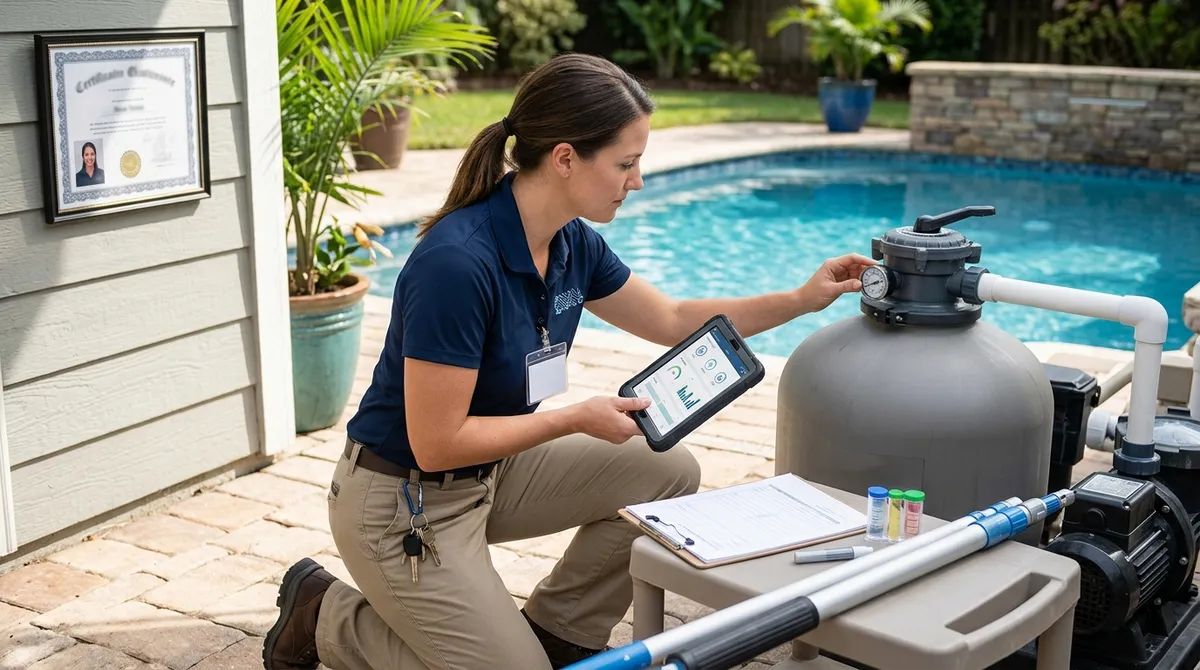
The term “licensed pool service” can mean different things depending on where you live. In Florida, the rules are pretty specific. Basic residential pool cleaning does not require a state contractor’s license. But the moment a technician touches your equipment — replaces a pump, repairs a heater, or fixes plumbing — a Swimming Pool and Spa Contractor’s License is legally required. You can learn more about these requirements directly from the Florida Swimming Pool Association (FSPA), which is the leading industry authority in our state.
For commercial pools, the rules go even further. Florida requires a Public Pool Service Technician Certification for anyone cleaning or treating commercial pools or spas. This means hotels, apartment complexes, and fitness centers all need technicians who hold this specific credential. If you manage a commercial facility, make sure you ask about this certification before signing any service contract. You can also explore why commercial pool service is essential for Tampa facilities to better understand what compliance really involves.
Why Licensing and Credentials Matter for Your Pool
Think of a licensed pool service the way you think of a licensed electrician. You would not let just anyone rewire your home. The same logic applies to your pool. Licensing is a sign that the company has met real standards — passed exams, shown experience, and demonstrated they understand both the technical and safety aspects of pool care.
Here is why credentials matter so much:
- Safety for your family: Proper chemical handling and water treatment protect swimmers from illness and injury.
- Equipment protection: Licensed technicians know how to service and repair equipment without causing further damage.
- Legal compliance: For commercial properties, using unlicensed services can lead to fines or shutdowns.
- Insurance coverage: Licensed companies carry liability insurance, which protects you if something goes wrong on your property.
- Long-term savings: Properly maintained pools cost less to repair over time. Learn more about pool filter repairs that save you money.
The Independent Pool and Spa Service Association (IPSSA) also provides ongoing education and resources for pool service professionals, helping raise industry standards across the country.

Florida Licensing Requirements at a Glance
Understanding the licensing landscape in Florida helps you ask the right questions. Here is a quick overview of what the state requires:
| Service Type | License Required? | Who Issues It? |
|---|---|---|
| Residential pool cleaning | No state license required | N/A (local permits may apply) |
| Pool equipment repairs | Yes — Swimming Pool & Spa Contractor License | Florida DBPR |
| Commercial pool cleaning | Yes — Public Pool Service Technician Certification | Florida DOH |
| CPO Certification | Professional credential, not a state license | NSPF / Pool & Hot Tub Alliance |
Florida pool service contractor applicants must show four years of proven construction experience to qualify for their license. The state also considers factors like credit history — applicants are generally expected to have a credit score around 660 or above. Up to three years of accredited college credit can substitute for some of that experience requirement. These are real standards that signal professional seriousness.
CPO Certification vs. a State License: What Is the Difference?
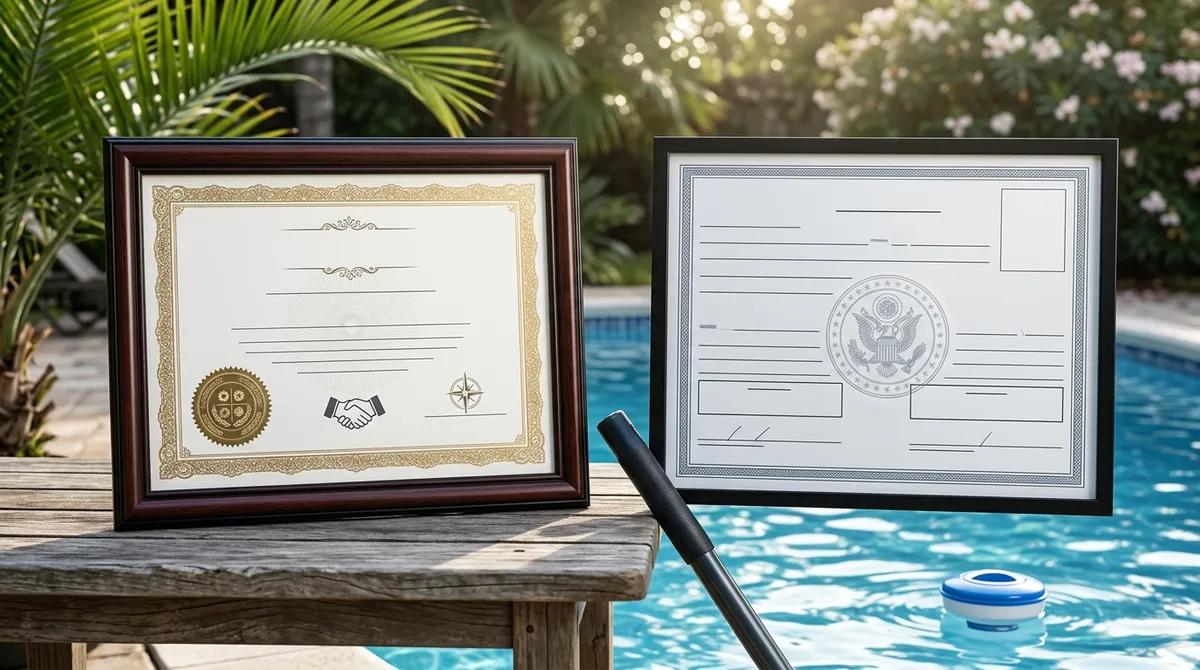
A lot of homeowners hear the term “Certified Pool Operator” (CPO) and assume it is the same as a state license. It is not — but it is still very valuable. Here is how the two compare:
- CPO Certification: A professional training credential focused on water chemistry, safety, and pool operations. It shows expertise but is not a legal requirement for residential cleaning in Florida.
- State Contractor License: A legally required credential for anyone performing equipment repairs or commercial pool service in Florida. Issued by the state after passing exams and meeting experience requirements.
- Both together: The best companies hold both — the CPO as a sign of knowledge and the contractor’s license as proof of legal authorization to perform repairs.
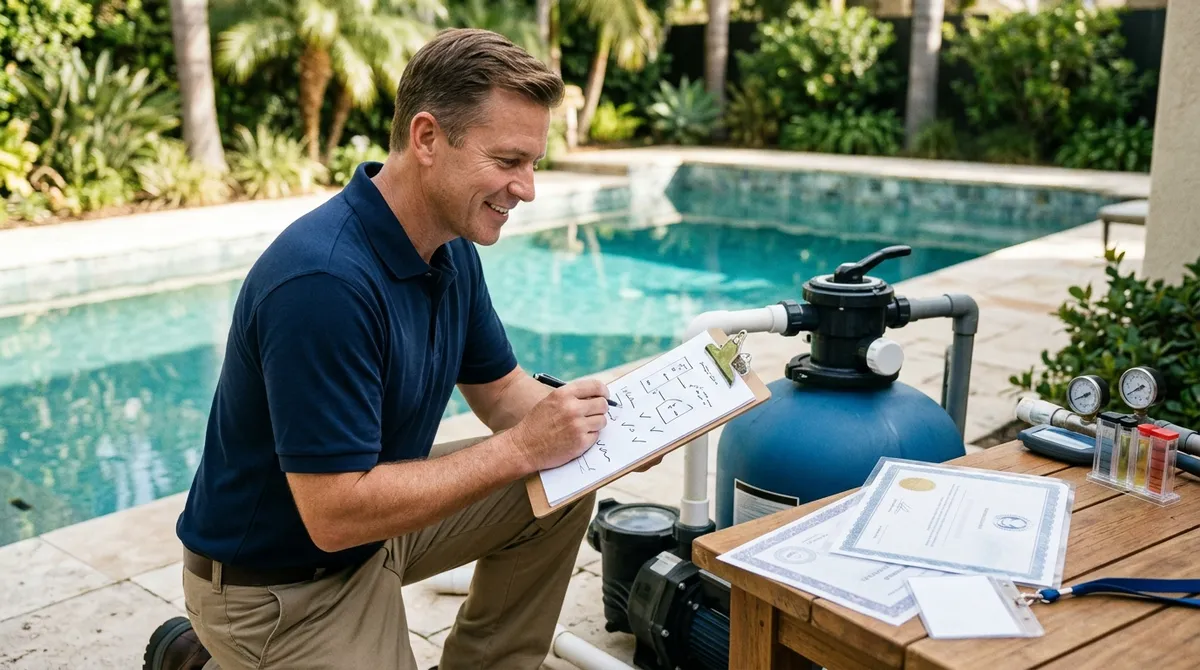
At Panther Pools, we hold both a Certified Pool Operator credential (CPO 648855) and a CPC License (CPC1461336). That combination means our team is trained, tested, and legally authorized to handle everything from routine cleaning to complex equipment repairs — all under one roof. You can find out more about our full range of pool cleaning services in Tampa.
How to Verify a Pool Service Company’s Credentials
Finding a licensed pool service company is not just about asking the right questions — it is about knowing how to verify the answers. Here is a simple step-by-step process:
- Ask for their license number. Any reputable company should be able to give you their Florida contractor license number without hesitation.
- Check the Florida DBPR website. The Department of Business and Professional Regulation has a free online lookup tool to verify any contractor license in the state.
- Confirm their insurance. Ask for proof of general liability insurance and, for employees, workers’ compensation coverage.
- Look for CPO credentials. A CPO-certified team understands water chemistry and safety at a professional level. Check out 9 things to know about certified pool operators in 2026.
- Read real reviews. Look for consistent feedback about punctuality, quality, and communication — not just star ratings.
- Ask about commercial vs. residential experience. These are different worlds, and the right company should be able to speak to both.
What Services Should a Licensed Pool Service Cover?
A truly full-service licensed pool company does much more than skim leaves off the surface. Here is what you should expect a qualified team to offer:
- Weekly or monthly pool cleaning and water testing
- Chemical balancing and water treatment
- Equipment inspection, repair, and replacement
- Pump, heater, and filter servicing
- Salt system and automation installations
- Acid washes, tile cleaning, and pool resurfacing support
- Commercial pool compliance and maintenance
When repairs come up, you want a team that handles them in-house rather than outsourcing to a third party. This matters for accountability, timing, and quality. If you have ever dealt with a pump problem, you know how fast a small issue can turn into a bigger one. Learn what to watch for with our guide on 7 pool pump repair signs you need help now.
The EPA’s pool water efficiency resources also offer helpful guidance on water conservation practices, which a professional licensed service will incorporate into their maintenance routines.
Red Flags to Watch Out For When Hiring
Not every company advertising “licensed and insured” actually is. Here are some warning signs that should make you pause before hiring:
- They cannot provide a license number. If they hesitate or give vague answers, that is a problem.
- No physical address or local presence. Fly-by-night operations often lack accountability.
- No written service agreement. A professional company will always put services and expectations in writing.
Also watch for companies that send inconsistent technicians, skip visits without notice, or rush through jobs. A pool cleaned carelessly is almost as bad as a pool not cleaned at all. For more on this, check out 7 signs of a truly reliable pool service in Tampa. And if you are managing a commercial pool, the stakes are even higher — compliance failures can result in real consequences for your business.
Licensing Rules for Commercial Pool Properties
If you manage a hotel, apartment complex, or fitness facility with a pool, you have extra responsibilities. Florida’s rules require that commercial pool water be treated and maintained by technicians with the proper Public Pool Service Technician Certification. This is not optional — it is part of staying compliant with health codes.
Here is what commercial property managers should prioritize when choosing a licensed pool service:
- Verify that the company holds the correct commercial pool certification, not just a residential cleaning background.
- Confirm seven-day availability, since pools do not take weekends off — and neither should your service provider.
- Ask about documentation and service logs, which may be required for health inspections.
- Ensure the company handles equipment repairs in-house so issues get resolved quickly.
You can also explore how to choose commercial pool services that keep facilities thriving for a deeper dive into what commercial clients need. For residential pool owners curious about what professional service truly covers, what a residential pool service actually does for you is a great starting point too.
How Panther Pools Checks Every Box
Tampa families, luxury homeowners, and commercial property managers deserve a pool service team that is not just good — but genuinely trustworthy. That is what Panther Pools was built to be. As a family-owned company serving Tampa and surrounding communities, we bring licensed, certified, and insured professionals to every single job.
We offer free estimates, monthly service packages, and customer support seven days a week. Whether you need routine weekly cleaning or a full equipment repair, our in-house team has the credentials and the experience to get it done right. And if you are in the West Chase area, we also offer dedicated Westchase pool service designed for your neighborhood’s needs. For residents looking for tips on keeping things running smoothly year-round, our 9 pool maintenance tips every Tampa owner needs in 2026 is a must-read.
We also know that life gets busy — whether you are a parent, a retiree, or a professional juggling a packed schedule. That is exactly why we built our service around showing up on time, doing the job thoroughly, and giving you one less thing to worry about. If you are wondering whether switching to a professional service is worth it, explore 6 reasons professional pool cleaning is worth it in 2026. You might also find it helpful to connect with trusted local partners like Dental Theory and DynaMight Movers, two fellow Tampa-area businesses known for putting their customers first — just like we do.
Your Next Step Toward a Cleaner, Safer Pool
Choosing a licensed pool service is not just a smart move — it is the right move. It protects your family, keeps your equipment running longer, and ensures your pool is always ready for the moments that matter most. Whether it is a Saturday afternoon swim with the kids or a morning lap before work, you deserve a pool that is clean, balanced, and safe every single day.
Do not settle for a company that cannot show you their credentials. Ask the questions, check the licenses, and choose a team that takes the job as seriously as you take your family’s safety. Reach out to our team at Panther Pools today for your free estimate and discover why Tampa pool owners trust us to keep their water crystal clear, season after season.
FAQs
Q: Do you need a license to clean pools in Florida?
A: Great news for homeowners — basic residential pool cleaning in Florida does not require a state contractor’s license. However, if any repairs or equipment work are involved, a Swimming Pool and Spa Contractor’s License is legally required. It is always smart to confirm what credentials your pool service company holds before they start work.
Q: Is a CPO certification the same as a pool service license in Florida?
A: Not quite! A Certified Pool Operator (CPO) credential is a professional training qualification that shows expertise in water chemistry and pool safety — but it is not the same as a Florida state contractor’s license. The best pool companies hold both, which means they are both knowledgeable and legally authorized to perform repairs and equipment work.
Q: What license is required for commercial pool cleaning in Florida?
A: Florida requires a Public Pool Service Technician Certification for anyone cleaning or treating commercial pools or spas, including those at hotels, apartments, and fitness centers. This is a separate requirement from the residential side of things, so commercial property managers should always verify this credential when hiring a pool service.
Q: What insurance should a licensed pool service company carry?
A: A trustworthy licensed pool service should carry general liability insurance to cover any accidental damage to your property, as well as workers’ compensation insurance for their employees. Always ask for proof of both before you sign a service agreement — it protects you just as much as it protects them!
Q: How can I verify that a pool service company is truly licensed in Florida?
A: It is easier than you might think! Ask the company for their Florida contractor license number, then verify it for free on the Florida Department of Business and Professional Regulation (DBPR) website. A reputable team will share this information without any hesitation — that transparency is a great sign of a company you can trust.